BOOK SHOP
Books for Sale
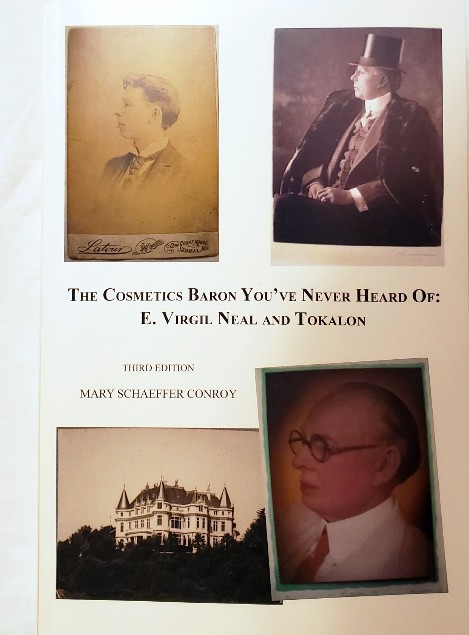
The Cosmetics Baron You Never Heard Of: E. Virgil Neal and Tokalon (Third Edition) - Mary Schaeffer Conroy - $20.00
This Book explores the adventures of E. Virgil Neal-his origins in post-Civil War Cole Camp, Missouri; his education and professorship at the Central Business College, Sedalia, Missouri and at Pierce College, Philadelphia; his authorship of banking and accounting tomes; his gigs as hypnotist and personal magnetism guru, his huckstering of health nostrums in Syracuse, New York and in the USSR; his glory days in Nice as husband of the lovely Renee; the dark days in Europe during World War II; and his relationship with underworld figures, downfall and demise. Tokalon still exists in Geneva, Switserland, under the ownership of Monsieur Ernst Buchert. Tokalon's fine cosmetics are sold around the world. The book also examines what made Tokalon profitable and long lived in the highly competitive environment of the perfume and cosmetics world. Many historical photos; 491 pages; archival materials, interviews and published materials, in notes and bibliography; index.
Collaboration With Germany by Georgians in France during World War II - Mary Schaeffer Conroy - $19.95
This book details military help to Germany by Georgians in Paris and other forms of collaboration with the German occupiers by Georgians and non- Georgians--like Corsican Etienne Leandri--during World War II. Historians have emphasized the complexity of collaboration in France. This book adds nuance to the topic. Based on dossiers from The Service historique de la Defense in Paris, it focuses on Georgians and others living in Paris, rather than Vichy. The dossiers reveal the Georgians' motivations and those of their national minority and French male and female assistants. Expecting Germany to win the war and dominate post-war Europe, the Georgians above all wanted to restore Georgian independence with German help. Described are Georgian relations with Germany from the 1880s through 1918, Georgian declaration of independence in 1918, Bol'shevik suppression of Georgian independence in the 1920s, military, material and intelligence aid to Germany by Georgians and others in Paris in World War II. The information gives perspective to Georgians' struggle for independence and closer relations with the West from the 1990s. It should interest historians of World War II and the Cold War.
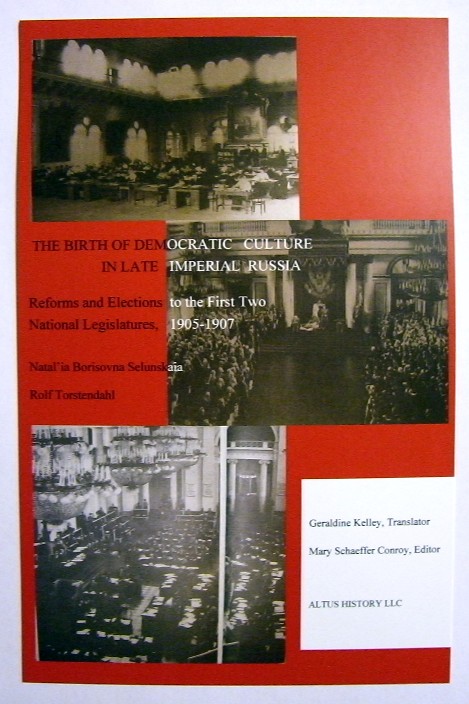
The Birth of Democratic Culture In Late Imperial Russia, by Natal'ia Borisovna Selunskia & famed Swedish historian Rolf Torstendahl, translated by Geraldine Kelley - $15.00
Pundits in 2022 claim that Russia never had good government. This is not true. The Russian government evolved from a top-down government in 16th century Muscovy to a political system that included a modicum of participation by city dwellers in city government during the reign Catherine the Great in the second half of the 18th century-- to participation in district and provincial government by property owners in 34 of Russia’s 50 European provinces in the second half of the 19th century—and, simultaneously, more rights for city dwellers—to participation in a national parliament from 1906 to 1917. The Birth of Democratic Culture In Late Imperial Russia, by Natal'ia Borisovna Selunskia & famed Swedish historian Rolf Torstendahl, translated by Geraldine Kelley and based on Russian archival sources, translated from the Russian into English, documents democratic electioneering, voting, and representation in six Russian provinces between 1906 and the beginning of the First World War in 1914. The book includes charts, bibliography and an index.
According to Selunskia and Torstendahl, the book presents a new view of the development of Russia at the concluding stage of the history of the autocracy. It's important features are: (1) the rejection of the term "revolution" in assessing the events of 1905, which did not result in an overthrow of the government or of the political system, but in reforms that took the place of a revolution; (2) demonstration of the close connection between the development of politicization and the expansion of democratic culture in Russian society with the election process for the first two Dumas and the formation of representative government as a whole, based on a study of a variety of archival and published sources at the local and national levels, and (3) a comparative historical evaluation of the reform of the system of government, democratization, and the developmentof the political sphere in Russia up to the June 3, 1907 reversal, which shows the Russian Empire to have been very close to the two other European empires--the German and Austro-Hungarian empires- and on a par with many countries of Western Europe.
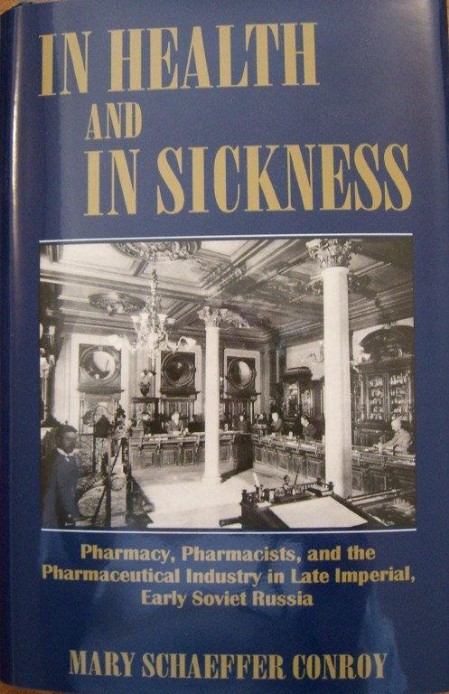
In Health and In Sickness: Pharmacy, Pharmacists, and the Pharmaceutical Industry in Late Imperial, Early Soviet Russia - Mary Scaeffer Conroy - $15.00
In Health and In Sickness: Pharmacy, Pharmacists, and the Pharmaceutical Industry in Late Imperial, Early Soviet Russia mirrors society, the economy, government, and revolutionary movements in the Russian Empire from the 19th century through the first two decades of the 20th century. Based on archival materials and published sources, this book not only addresses health care but adds chiaroscuro to a complex and crucial era. The book provides a case study of the results of excessive government interference in the economy but also the dynamism of pharmacist entrepreneurs. The fate of pharmacy and the pharmaceutical industry after 1917 begins to answer the question of how the Soviet pharmaceutical industry lost world-competitive status.
This panoramic volume of 703 pages, including notes, bibliograph, index, and photos, address the following topics: government regulations for establishing and operating pharmacies in Imperial Russia; competition to privately owned pharmacies from socialized city and zemstvo pharmacies and drug stores; the training and education of pharmacists; Polish and Jewish pharmacists who comprised approximately two-thirds of the profession; the education and achievements of women pharmacists who entered the profession in 1888; pharmacists’ pharmacognosy and pharmacological research; the achievements and the problems of the pharmaceutical industry in Imperial Russia; famous pharmacists like V.K. Ferrein, R. Keler, and Antonina Lesnevskaia; phytotherapy; pharmacists’ contributions to public health; drug use and abuse in Tsarist Russia; pharmacy journals and societies; the pharmacists’ pension fund, radical (Marxist) pharmacists’ proposals to eliminate private pharmacies; The Russian Pharmaceutical industry during World War I; Marxist organizations and the activities of Marxist pharmacists in the upheavals of 1905 and the revolutions of 1917; government (particularly P. A. Stolypin’s) policies for the advancement of the pharmaceutical industry, pharmaceutical education, and the ending of privately-owned pharmacies; nationalization of pharmacies after the Bolshevik Revolution of 1917.
Medicines For The Soviet Masses Dueing World War II - Mary Schaeffer Conroy - $15.00
According to conservative estimates 25 million Soviet citizens, most civilians, died during the Great Patriotic War, 1941-1945. They might not have had Soviet medical care been better. Although Soviet publicists claimed their health care was excellent, in fact new archival evidence shows that there were serious shortages not only of anesthesia, sulfa drugs, and other state-of-the-art medicines and medical equipment, but also basic items like soap and disinfectants--not only during the war but well before it. This book has three foci. On the basis of new materials from Russian archives, it examines the diseases prevalent and the therapies and equipment available to counter them in the years before the Great Patriotic War and then during it. Issues such as evacuation of pharmaceutical factories and citizens are addressed. The book not only provides a corrective to the standard view of Soviet health care, it also shows how a mid-level industry performed during the war. Finally, through interviews with Soviet citizens who were teenagers or young adults during the war, and pharmacological journals, the book emphasizes how ordinary people and also health professionals and pharmacologists turned to narodnaia meditsina--popular, traditional medicine--to compensate for lack of factory-produced items, steering Soviet medicine into a different trajectory--until recently--from American medicine. This book of 256 pages has figures and tables, a bibliography and an index.
Peter Arkad'evich Stolypin: Practical Politics in Late Tsarist Russia - Mary Schaeffer Conroy - $30.00 (Only 4 left)
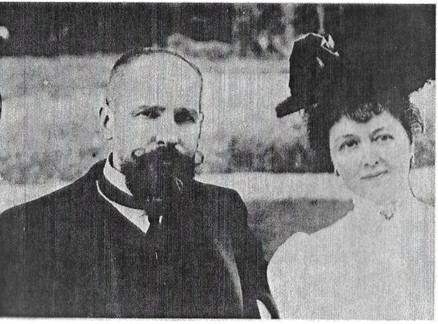
Peter Arkad'evich Stolypin, Governor of two Russian provinces, then Russian minister of internal affairs and chairman of the Council of Ministers under Tsar Nicholas II from 1906 to 1 911 - when Stolypin was assassinated - was one of the chief figures in the Russian government during a critical period in its history. Stolypin used harsh methods to crush revolutionary movements and he opposed nationalist breakaway movements on the part of Finns, the Armenians and other border nationalities. But he also sought to improve peasant land holding, local government, and the lot of Jews and Old Believers, the last considered heretical by the Orthodox Church.. His major achievement was preserving the new Russian Parliament—the lower house, the State Duma and the upper chamber, the revised State Council. Although he agreed with the summary dismissal of the first two State Dumas, because of the representatives’ fractious and feckless behavior, the Third State Duma, which lasted its full five year term, cooperated as well as countered the Tsar and his minsters and began to act like a viable parliament of the Western European type. Research for this book occurred during the Soviet period when Russian archives were closed to Western scholars. However, Dr. Conroy used Finnish, American, and British archival materials and interviewed individuals who worked under Stolypin, most notably Prince Aleksei Obolenskii, an expatriate living in Stockholm, and Maria von Bock, Stolypin’s eldest daughter, residing in San Francisco, California. More information on Stolypin’s handing of pharmacy and the pharmaceutical industry is contained in a later publication, edited and contributed to by Professor Conroy, Emerging Democracy in Late Imperial Russia (University Press of Colorado, 1998). This volume also contains more information on Finnish-Russian relations, the development of the State Council, liberals and Stolypin, and the causes of World War I.
Stolypin became an icon in Post-Soviet Russia. Professor Conroy was invited to participate in symposia held in many parts of Russia, Ukraine, and Lithuania during 2011 and 2012. which commemorated the centenary of Stolypin’s assassination and the 150th year of his birth, sponsored by Pavel A. Pozhigailo.
Emerging Democracy in Late Imperial Russia (University Press of Colorado, 1998) - Edited by Mary Schaeffer Conroy - $30.00
This compilation analyzes the increasing participation of citizens in politics and the development of political parties at the local as well as the national level in Russia from the 1880s through 1917. 316 pages, maps, figures, notes, index. This book provides an outstanding refutation of the notion, promulgated by The New York Times in the 1990s, that “Russia never experienced democracy.”
Chapter 2: “The Tsarist Government’s preoccupation with the ‘Liberal Party’ in Tver’ Province” by Charles Timberlake, Professor at the University of Missouri, now sadly deceased, discusses the attempts of progressives (many related to the famous anarchist Michael Bakunin) to control local affairs through newly established zemstvos--local councils comprised of large landowners, businessmen, and peasants—by electing zemstvo leaders, taxing, and hiring specialists—in the face of opposition from local governors and governmental authorities.
Chapters 3 “The Zemstvos and the Transformation of Russian Society” and Chapter 8, “The Democratization of the Zemstvo During the First World War” by Thomas Earl Porter, currently Professor of History and Political Science, North Carolina Agricultural and Technical State University, and Dr. William Gleason, currently Coordinator of Advanced Polish and Ukrainian Studies and Coordinator of Eurasian Area Studies, Foreign Service Institute, U.S. Department State, discuss zemstvo representatives’ increasing participation in Russian politics by helping to provision troops during the 1904-1905 Russo- Japanese War, by helping with the mechanics of P. A. Stolypin’s program to encourage peasants from European Russia to farm in Siberia, and by provisioning troops and assisting with other exigencies resulting from World War I.
In Chapter 4, Dr. Dittmar Dahlmann, currently Emeritus Professor, Abteilung für Osteuropäische Geschichte, Institut für Geschichtswissenschaft, University of Bonn, Germany, discusses “Liberals in the Provinces: The Kadets and Duma Elections in Saratov, 1906-1912”. The Constitutional Democrats or “Kadets” were a major liberal-Leftist Party in Russia in the early 20th century until the Bolshevik takeover in 1917. They particularly dominated the First State Duma, Russia’s new parliament, in 1906.
Chapter 5, “P. A. Stolypin, Marxists and Liberals versus Owners of Pharmacies and Pharmaceutical Firms in Late Imperial Russia” by Mary Schaeffer Conroy , Professor Emerita, Russian History, University of Colorado, Denver, USA, reveals Stolypin’s plans to advance the Russian pharmaceutical industry—at the expense of European firms--and also the momentum on the part of government officials—as well as liberals—to transfer privately owned pharmacies to public ownership—well before the Bolsheviks nationalized pharmacies and pharmaceutical factories after their takeover in late 1917.
In Chapter 6, Antti Kujala, currently Professor, Department of Philosophy, History, Culture, and Art Studies, University of Helsinki, Finland, discusses “The Policy of the Russian Government Toward Finland, 1905-1917: A Case Study of the Nationalities Question in the Last Years of the Russian Empire.” This chapter alone is extremely important for understanding President Putin’s contemporary attitude toward Ukraine, Georgia, and other nationalities relationship to Russia’s federal government.
In Chapter 7, “Nationalist Politics in the Russian Imperial State Council: Forming a New Majority. 1909-1910, Alexandra Korros, currently Professor Emerita, Department of History, Xavier University, Cincinnati, Ohio, USA, documents that the upper chamber of the new Russian parliament, the revised State Council, was becoming an upper parliamentary chamber analogous to those in Western Europe.
Chapter 9 “Interregional Conflicts and the Collapse of Tsarism: The Real Reason for the Food Crisis in Russia After the Autumn of 1916” by Kimitaka Matsuzato, currently Professor, Graduate School of Law and Politics, University of Tokyo, Japan, analyzes in fascinating detail and from an economic point of view, one of the major causes proffered for the fall of the Tsarist government in 1917.